George Yeoman Pocock
The Boys in the BoatGeorge Yeoman Pocock was a boatbuilder, technical authority, and mentor whose influence on University of Washington rowing reached well beyond the racing shells he crafted. His knowledge helped shape the Conibear stroke, while his reflections on trust and collective effort supplied the spiritual dimension of the sport that generations of oarsmen encountered in the shell house and on the water.
Identity and Background
Pocock was born in Kingston upon Thames on March 23, 1891, into a family whose livelihood had been bound to boats for generations. His paternal grandfather built rowboats for the professional watermen who worked on the River Thames, ferrying passengers and providing water-taxi services. The family trade grew out of a rowing culture with sharply contrasting faces: informal races could be rough contests in which spectators obstructed boats or dropped stones from bridges, while the annual Doggett’s Coat and Badge race, held since 1715, wrapped competition in ceremony. Its winner earned the right to wear a crimson coat and knee breeches, a silver badge, and white stockings. Pocock’s inheritance was therefore not only the craft of boatbuilding but a long tradition in which rowing could be both labor and spectacle.
He was described as nearly born with an oar in his hands. His own formation included instruction from Thames watermen and teaching boys at Eton College. That combination of practical knowledge and formal rowing experience would later matter in the western United States, where established eastern conventions did not necessarily produce the most effective stroke.
From Boatbuilder to Technical Innovator
Pocock came to the attention of the University of Washington through Hiram Conibear, who sought a fleet of racing shells and invited the Pocock family to move from Coal Harbour to the University of Washington campus. The proposed order was ambitious: perhaps fifty shells, and no fewer than twelve. The family visited the campus and sent word to their father in England to come join them. Only after he had begun the Atlantic crossing did a letter clarify that Conibear had enough money to buy just one shell. The scale of the opportunity had abruptly contracted, but the Pococks settled on campus all the same.
Once there, Pocock watched the oarsmen and noticed mechanical flaws that could not be corrected by adjusting a rowing skeleton. Initially reluctant to volunteer advice, he spoke when Conibear asked for the family’s opinion. He began sharing elements of the stroke he had learned from Thames watermen and taught at Eton College. Their discussions, rather than a solitary invention, produced the technique that came to be known as the Conibear stroke.
The new method replaced an exaggerated backward lean and long recovery with a shorter layback, a quicker catch, and a shorter, more powerful pull. At the end of the stroke, rowers sat more upright and could slide forward sooner to begin again. The approach differed conspicuously from the style favored by eastern schools, including Eton College. Its early success in producing significant victories drew attention from those same schools, which tried to understand how a stroke that looked unorthodox could be so effective. Pocock’s contribution lay in bringing embodied craft knowledge into conversation with Conibear’s coaching, helping a regional program develop a distinctive method.
The Builder in the Shell House
After the First World War, Pocock’s brother Dick moved east to build shells for Yale University; George remained in Seattle rowing and labor-conflict city. Orders for his carefully made shells arrived from around the country, and he continued working in the loft of the University of Washington shell house. His expertise ranged across the physical workings of the sport: the interaction of water, wood, and wind, and the biomechanics of muscle and bone. Successive coaches and crews came to recognize that the quiet builder above them understood rowing in a depth few could match.
The boys first saw him not as a distant authority but as a figure behind Tom Bolles while the coach addressed new rowers. Tall, wearing horn-rimmed spectacles and a carpenter’s apron marked with red sawdust and curls of cedar, he watched and listened. His crisp British accent and unusual haircut made him recognizable, and the boys knew he built racing shells for the University of Washington and programs elsewhere. They did not yet know that the deeper ideas in Bolles’s talks had much of their origin in Pocock’s own reflections. The narrative thus introduces him first as a presence at the edge of the scene, then reveals that his influence runs through what the boys are being taught.
A Philosophy of Collective Effort
Pocock’s technical command was only the beginning of his influence. As he watched generations of young men strive to master rowing, he learned to see potential obscured by ego or anxiety and to recognize how fragile confidence could be. He also observed the affection that could grow between two oarsmen or among an entire crew when they worked honestly toward a shared task. Trust, in his understanding, was not an abstract virtue added to athletic performance; it could change what a crew was capable of doing.
When such bonds were nurtured, nine boys could become, in the book’s formulation, one thing: a crew so attuned to water, earth, and sky that effort gave way to ecstasy. Pocock regarded that transformation as rare and sacred, and his quiet counsel made him a spiritual guide within the rowing community. Bolles’s talks about hardship, character, fellowship, and moments that brought rowers nearer to God echoed this outlook. The boys were warned that only a few would endure the physical and mental tests required to earn a place on the team, but were also offered the possibility of becoming part of something larger than themselves. Pocock’s role connected those two claims: the discipline mattered because it could make genuine cooperation possible.
Rowing, Status, and Legacy
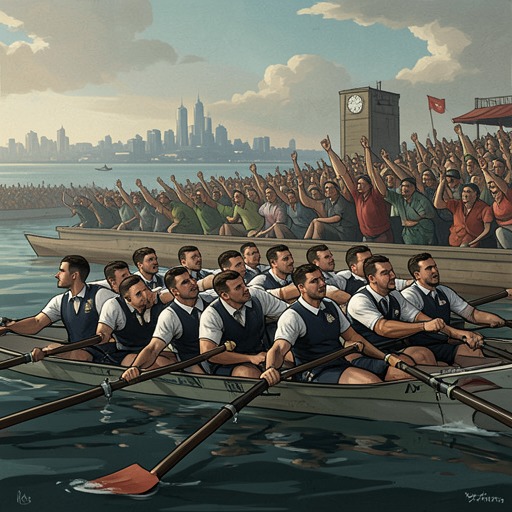
Pocock’s work took place within a sport whose social standing was changing. Collegiate rowing drew large crowds and extensive press coverage in the 1920s and 1930s, while western fans increasingly rallied around the rivalry between the University of Washington and the University of California, Berkeley. Western programs had struggled for recognition and resources, and the eastern colleges still dominated the prestigious Poughkeepsie regatta. When the University of Washington first competed there in 1913, its crew placed third, startling eastern spectators accustomed to western teams as outsiders. Pocock’s technical and craft expertise belonged to a larger effort to make western rowing competitive, though the book does not reduce that effort to boat design alone.
The sport’s ideals of refinement also concealed barriers of class. At the Henley Royal Regatta, a rule excluded people employed as mechanics, artisans, or laborers; the Australian policemen were treated as laborers and barred from competing. This exclusion illuminates the social hierarchy surrounding a sport in which Pocock, himself a working boatbuilder, became an essential authority. The evidence does not present him as an opponent or reformer of that rule, but it sets his practical craft knowledge against the prestige attached to amateur status and elite institutions.
Pocock’s legacy therefore joins material skill to an account of what rowing could mean. He built shells and helped refine a stroke, but he also interpreted the crew as a form of human cooperation in which trust could turn separate exertions into a shared motion. His formulation of rowing as an art approaching perfection when performed well culminated in the claim that such perfection could bring a rower near the Divine. In the book, that vision makes Pocock more than the expert in the shell-house loft: he is the figure who gives technical excellence its larger purpose.